  |
||
ACCOMPANIMENT We live in unprecedented times. A vast array of developments and forces are coalescing to create an ever-more complex environment. It is under such a scenario, that the need for organizations to begin to function in a different manner is more than ever necessary. The techniques of linear and sequential thinking that have been the mainstay of organizations till date is proving to be inadequate in maneuvering the environment, and a new way of perceiving it, and a new way of mobilizing the creativity inherent within individuals and collectivities within the organization, is being called for. Aurosoorya has developed such an approach to building creative organizations. 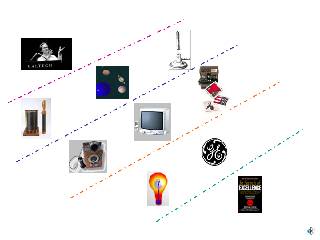 The question is, is there a process or method to creativity? Richard Feynman, the noble laureate physicist is known to have said “To develop working ideas efficiently, I try to fail as fast as I can.” Even in looking at fundamental laws that apparently govern our universe – such as Electromagnetism, Newton’s Laws of Mechanics, Spectrography, amongst others, we find that certain acts of randomness seemed to have governed their emergence. In 1820, Oersted, for example, in a public lecture where he was trying to prove the separateness of electricity and magnetism, found that his experiment failed. He was forced to postulate the possibility that electricity and magnetism were in fact one and the same force. This gave rise to the field of electromagnetism. Even in looking at inventions, such as the telephone, television, and instant photography, we find that acts of randomness were responsible for these developments. Thus, Alexander Graham Bell, for example, because of his German language barrier misinterpreted a German document to think that it was describing the telephone. It was in fact describing something quite different. He then went on to invent the telephone. Looking at markets and companies we find the same phenomena occurring. Von Hipple’s Law of User Innovation states that in the electronics industry 70% of inventions come from the user, rather than from the companies that had created the initial devices. Even Tom Peters, in his “In Search of Excellence”, concluded that the most innovative companies followed a rule of “Fire, Aim, Ready”, rather than “Ready, Aim, Fire”. 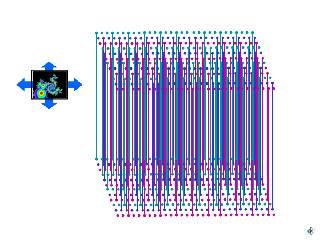 While no ordered process of creativity seems to emerge, what does emerge is the need for non-obvious interconnections. For in each of the previous cases we find that the process of creativity was facilitated by unintentional interconnections. This suggests that interconnections – horizontal, vertical, depth-wise, perhaps need to be strived for in attaining to the creative process. Perhaps, the process of making non-obvious interconnections has to be institutionalized.  There are surely many ways in which non-obvious interconnections can be made. Aurosoorya believes, however, that there is an art to making the right non-obvious interconnections. The art involves a science, and the science necessitates understanding naturally occurring fractals in nature. Consider broccoli and fern as examples of naturally occurring fractals. In looking at the broccoli, one observes that the fundamental shape of the broccolette is repeated in the stem, which is repeated in the shape of the broccoli. Similarly, the shape of the smallest leaf in the fern is repeated in the smallest branch, which is repeated in the sub-branch, which is repeated again in the shape of the fern. Nature seems to deploy a technique of self-similarity repeated at different scale to create these irregular structures. Further and importantly, in seeing the fractal pattern, a whole different degree of non-obvious interconnections comes into focus. For suddenly, seemingly unconnected levels within the same structure seem to be intricately and intimately connected. The question is, can this same process of self-similarity repeated at different scale be employed to understand something of the structure, dynamism, and hence creativity in organizations? 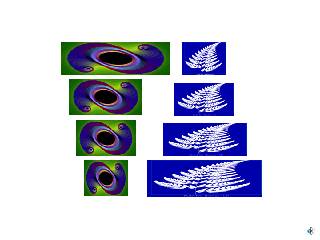 Aurosoorya believes that adopting a fractal view of organizations is like using a telescope to observe the night-sky. In the absence of a telescope one may observe the night sky through the bare eyes to gain insight into the movement of celestial bodies. In using a telescope however, new insights, new connections, a new nature to stars and planets is revealed that brings into emergence a new body of knowledge, with a new and more detailed understanding of why objects move the way they do, and how some of these objects relate to others, and how and why they differ. Similarly, adopting a fractal view of organizations brings into focus a new body of knowledge. A level of organizational dynamics is revealed that is unavailable with the use of conventional organizational seeing and thinking. 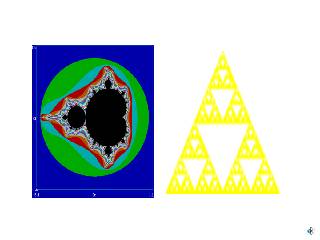 It is significant that if such a thing as an organizational fractal exists, then by virtue of repeating itself at each level of the organization, it must impact or even perhaps determine the nature of each level of the organization, whether individual, team, organization itself, output of organization, or system within which the organization exists. Further, it must interconnect each level, not arbitrarily, but in a living and important manner, such as occurs in a broccoli or fern. Otherwise, it would not qualify as being a fractal. Of course, being that the fractal in question is one for a human-based organization, it would likely have to be more complex than the one that exists at the purely physical level. Aurosoorya believes that a fractal for human organizations would embody dynamic characteristics, as opposed to the purely static fractal that exists in so much at the physical level of Nature. Aurosoorya believes that the dynamism would itself reflect the creativity inherent in all structures that make up our world. The fractal thus, could perhaps be thought of as being the creative quanta animating all organization. 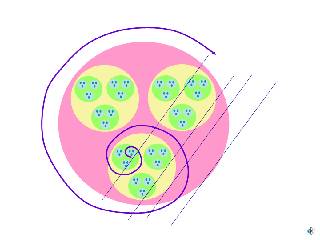 If these fractal characteristics, of determination of aspects of a level by virtue of the organizational fractal, and interconnectedness of levels, exist for an organization, then we have suddenly gained a view and insight into organizations that could fundamentally change the nature of understanding and therefore mobilizing organizations. To start with, non-obvious and highly significant interconnections between levels within an organization, and even with the vaster system within which an organization exists, comes into focus. Imagine this hypothetical fractal in front of us as being the organizational fractal. The fundamental pattern is one of 3 circles within a circle, which repeats itself at smaller and smaller or larger and larger scale, depending on one’s point of view. Imagine, further, the small blue circle to represent the organizational fractal at the individual level. This same base-pattern repeats itself at the team level, represented by the larger green circle, again at the organizational level, represented by the even larger yellow circle, and finally at the system level, represented by the even larger pink circle. Now, if the organizational fractal at the level of individual changed, then its effects would ripple through and change each of the other levels. This would only happen, of course, if the true organizational fractal had been identified, where the nature of each level and the connectedness between levels is determined by the fractal itself. Many other implications would exist. But first, the organizational fractal would have to be identified. 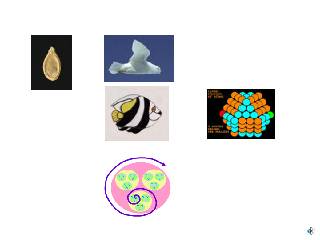 This approach is in fact consistent with Nature’s design efficiency. Take the example of the seed. Nature ensures that seeds are streamlined so that they have a higher chance of penetrating the earth on impact. In this manner the process of germination is more likely to happen, thereby allowing Nature to propagate her plant species with the least amount of energy. Similarly, birds that fly and fish that swim are also streamlined to ensure that the least amount of energy is expended when they move through their respective mediums. Even at the molecular level, atoms are packed together in such a manner so as to expend the least amount of energy. Use of an organizational fractal in the design and management of organizations would be consistent with this approach, since the fractal in question would not only contain the information needed to create something of each of the levels in an organization, but further, would connect them together in an intimate and meaningful way. Thus, here too, the least amount of energy would be expended in creating and managing the larger organization. 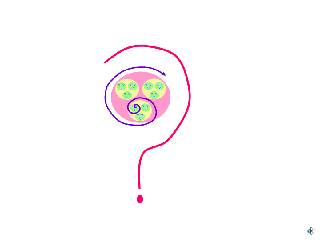 So, what is the organizational fractal? 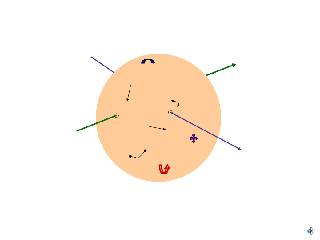 Let us assume for a minute, that we have identified the organizational fractal. This would imply that new knowledge with regard to the dynamics of each of the levels of the organization would come to the surface. Thus, we would gain important insights into the nature of individuals, teams, departments, the organization itself, the output of the organization, and the system within which the organization exists. But this new knowledge would be ineffective unless we could begin to understand the fractal space within which the new dynamics seems to occur, and unless we could develop the tools and means to navigate through this emergent fractal space. 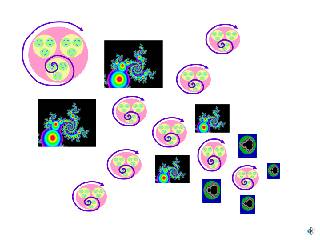 Through conducting extensive research at each of the levels that constitute an organization, and through isolation of fundamental patterns that repeat themselves at each of these levels, Aurosoorya believes that it has in fact, identified the organizational fractal. On study of the identified organizational fractal, many implications emerge. These implications shed light on the emergent fractal space, and in fact begin to provide a means by which navigation through the fractal space becomes possible. Amongst the large number of implications that have come to the surface are included universality, multiple fractal mastery, fractal completion, fractal influence, stuck-point fractal, evolution of fractals, and fractal leadership, for example. Each of these describes new ways in which individuals, teams, and organizations, would need to act in the fractal space in order to begin to effectively mobilize creativity. Based on an understanding of the underlying organizational fractal and the resulting implications, Aurosoorya has also developed a number of down-to-earth recommendations by which the tremendous insights from a fractal view could begin to be immediately incorporated into the day-to-day running of an organization. 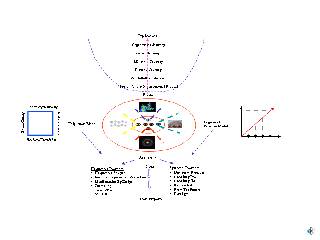 In building the creative organization, identification of the organizational fractal is the starting point. This will lead to the study of a number of implications, through which knowledge of the fractal space will increase. Effectively maneuvering through the fractal space necessitates the development of fundamental tools. Aurosoorya has developed 2 powerful tools by which effective navigation can begin to take place. The first is a tool that begins to integrate or synthesize layers of the fractal strata in a meaningful way. The second is one that helps with the identification of uniqueness of entities in the fractal space. These tools of synthesis and uniqueness represent a key means by which to master the fractal space. Correspondingly, Aurosoorya has designed a number of supporting exercises by which these 2 master tools can themselves be mastered. 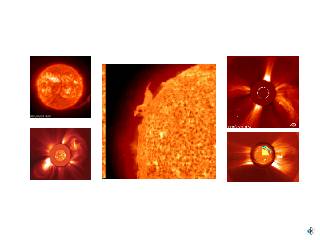 The fractal organization will be like the core of the sun. The core of the sun extends to 25% of the sun’s radius. It is a region of intense pressure in which the very dynamics of interaction changes. Thus, elements that under normal circumstances would never combine begin to combine in this altered region. The process of fusion results and subsequently vast amounts of energy and light are created. The fractal organization would operate in a similar fashion. It would allow, or rather institutionalize, the process of making non-obvious interconnections. Ideas, entities, people, would begin to come together or combine to create results that under normal circumstances would not occur. Hence, new services, new products, new strategies, new modes of management, new organizational structures, will more easily come to the surface. The organization will thereby be better equipped to chart out its unique destiny, to begin to create a meaningful impact in the marketplace.  Aurosoorya welcomes dawns of creativity. Aurosoorya is currently involved in offering workshops, talks, online training, consulting services, and turnkey projects specializing in the area of creativity and innovation. Aurosoorya is also involved in cutting-edge research at the intersection of New Science, Application of Consciousness, and Design and Management of Organizations. Aurosoorya has also designed a number of software tools to assist individuals and teams to mobilize their creativity, through mastery of the fractal space. 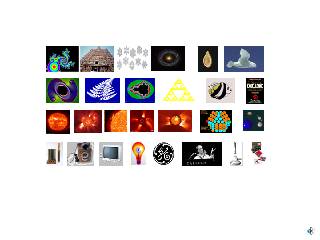 Aurosoorya acknowledges the use of several images in the creation of this presentation. The images of the Sun were obtained from the joint NASA/ESA site. Images of fractals, including the Mandelbrot Set, Serpinsky’s Triangle, Lamba Series, and Julia Set, amongst others were obtained from Sprott’s Fractal Gallery. The image of the packed atoms was obtained from work of Buckminster Fuller. The image of the Ring Galaxy was obtained from NASA’s archives. Other images were used, and Aurosoorya, while unable to site individual sources, gratefully acknowledges their use and thanks their creators. Finally, Aurosoorya acknowledges the use of music by Sunil, of Sri Aurobindo Ashram, Pondicherry, India. |
||
 Back
to Aurosoorya Analysis Back
to Aurosoorya Analysis |
||
Home | FractalKey |
PowersWithin | Within | Flowering
of Organizations
|
||
|
|
||
| |
||